
FAAC Gate Repair in Grapevine: A Homeowner’s Guide
FAAC gate openers communicate their problems through a series of LED blink codes on the control board. Most homeowners never learn to read them, so they call a generalist who replaces parts by guesswork. This guide explains the three codes we see most often in Grapevine, the difference between a hydraulic and electromechanical FAAC unit, and how to tell a $10 firmware reset from a $300 board replacement before you spend a dime.
If you’d rather not sort through blink codes yourself, call (432) 237-4128 and we’ll talk you through it. A live person answers, day or night.
What Your FAAC Opener Is Trying to Tell You: Reading the Blink Codes
The FAAC control board sits inside the operator housing, usually behind a small plastic window or under a removable cover. When something goes wrong, a red LED blinks in patterns that correspond to specific faults. These codes are in the manual, but most homeowners never open it, and most handymen never read it either.
In Grapevine, we see three codes more than any others:
- Two blinks, then a pause, repeating: This is a photocell or safety-edge obstruction signal. It usually means the beam is blocked by a weed, a trash can, or caliche dust caked on the lens. Cleaning the lens with a dry cloth fixes this more often than not. If the code persists after cleaning, the photocell may be misaligned or failing, which is a simple swap.
- Three blinks, then a pause: The board is reading a force-trip. The gate hit resistance while moving, and the opener shut down to protect the motor. On a hydraulic FAAC, this often points to low hydraulic fluid or a stiff hinge. On an electromechanical unit, it’s usually debris in the track or a wheel that’s seized. We pulled a three-blink call from a home off Dove Loop Road where two years of caliche dust had packed the rail so solid the gate was grinding against it.
- Five blinks or a solid LED that never clears: This is the one homeowners dread and often misdiagnose. It indicates a board-level fault. But here’s the distinction that matters: a solid LED with no response after a power cycle means the control board has failed. A flashing five-blink pattern that resets when you cut power for 30 seconds means the firmware has locked up, which is a 10-minute reset, not a $300 board replacement.
If you’ve already opened the housing and you’re staring at a solid red light, call us before you order a board. Half the time we can revive it with a firmware reset and save you the cost of a part you didn’t need.
Hydraulic vs. Electromechanical: Why the Difference Decides the Repair
FAAC makes two distinct lines of operators, and confusing them is the most common misdiagnosis we see from non-specialist repairers in the Fort Worth corridor.
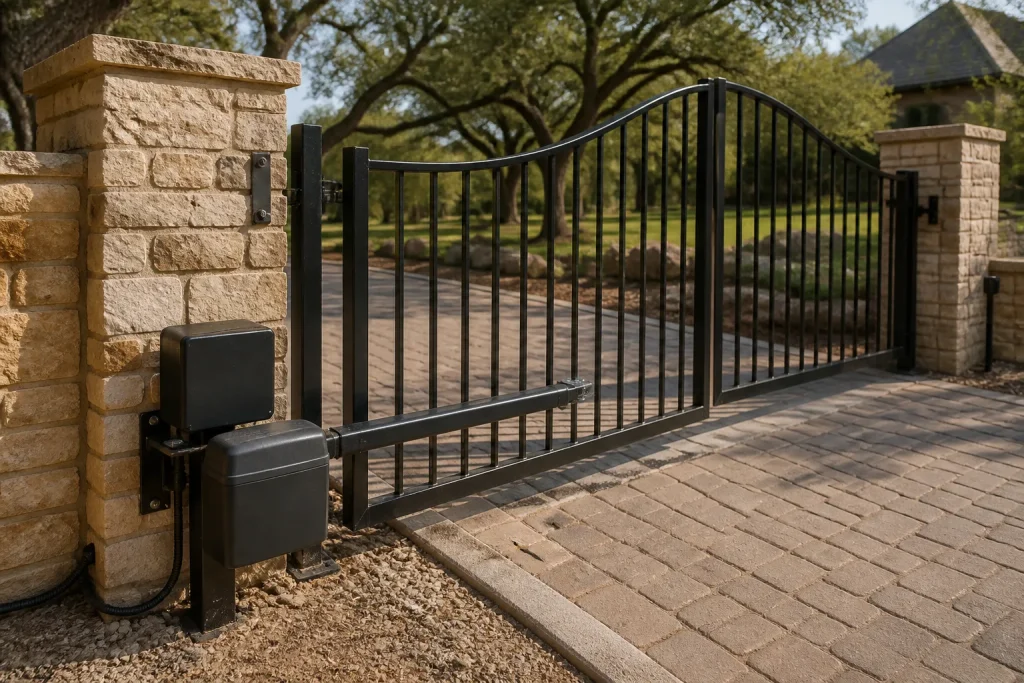
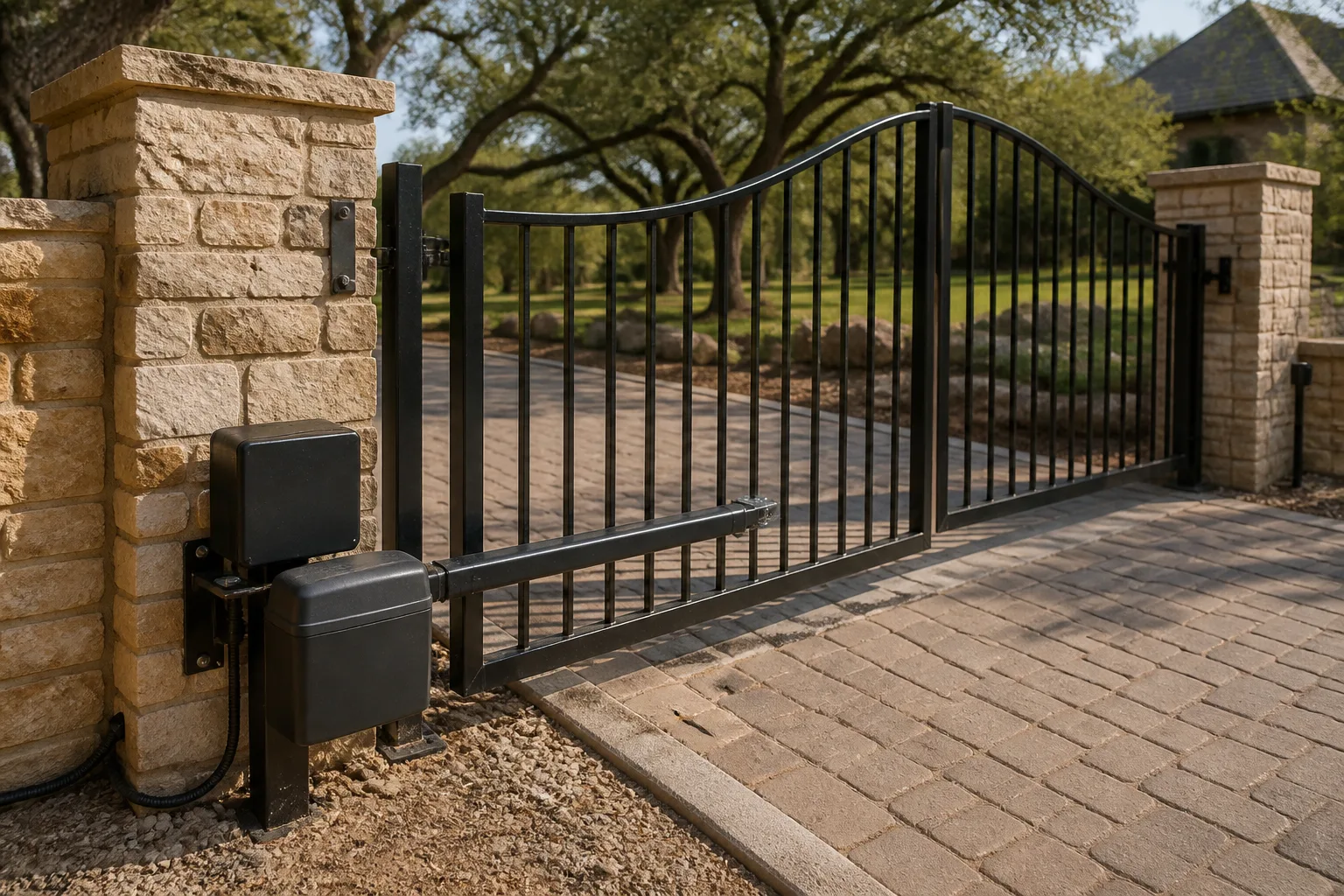
Hydraulic FAAC units use oil under pressure to move the gate arm. They’re common on heavier estate gates and older installations. When they fail, the symptoms are gradual: the gate moves slower in cold weather, it hesitates mid-travel, or it stops holding position. The fix is often as simple as topping off the hydraulic fluid or bleeding air from the system. A repairer who doesn’t know FAAC will swap a motor that’s perfectly fine and hand you a bill for it.
Electromechanical FAAC units use a screw or worm drive turned by a DC motor. They’re lighter, quieter, and more common on newer residential gates. Their failures are usually electrical: a capacitor that swells in the heat, a limit switch that drifts, or a control board that quits after a voltage spike. The repair is component-level, not fluid-level.
Here’s the Grapevine-specific pattern we’ve observed over years of calls: hydraulic FAACs in North Texas tend to develop slow leaks around shaft seals after seven or eight summers. The heat thins the oil and the seal hardens. Electromechanical units tend to kill capacitors in four to five years, because a capacitor sitting in a metal housing under a Texas sun is effectively baking at 130-plus degrees every afternoon from June through September.
If you know which type of unit you have, you’re already ahead of the person who shows up to guess.
Why Grapevine Weather Is Harder on FAAC Openers Than You’d Think
Grapevine sits at the top of the Trinity River basin, and the soil here matters to your gate. Caliche, that pale chalky limestone layer under the topsoil, turns to fine alkaline dust during dry spells. That dust gets into every opening on an exterior operator: the cooling vents, the limit-switch housings, the photocell lenses. It’s worse in the stretch along Grapevine Mills Parkway and up toward the lake, where construction and open ground keep particulate levels high.
Dust shortens the life of a FAAC board in two ways. First, it insulates heat. A control board that should run at 120 degrees inside the housing will run at 150 when it’s wearing a coat of caliche. Second, it bridges contacts. A tiny layer of conductive dust across a solder joint creates resistance, and resistance creates heat, and heat kills capacitors. We have changed FAAC boards that died in three years where the same unit in a coastal climate would have lasted ten.
There’s a second weather factor: the 100-plus-degree days in July and August. FAAC rates their operators for a certain ambient temperature range, and a black steel housing mounted on a west-facing gate post will exceed that range every afternoon. The board goes into thermal shutdown, the gate stops mid-cycle, and an hour later it works fine when you test it. That intermittent failure is maddening, but it’s diagnostic: if your FAAC only fails during the hottest part of the day, you have a heat-related component failure, not a motor problem.
The practical takeaway for gate repair in Grapevine is simple: clean the operator housing once a season, and note whether your failures correlate with afternoon heat. That information saves a technician an hour of diagnosis.
Firmware Reset or Board Replacement: The Symptom That Separates Them
This is the section that has saved our customers real money, so read it closely.
A FAAC control board has two kinds of memory: the firmware that runs the gate’s logic, and the configuration settings that tell it how long to run, how much force to apply, and where the limits are. A firmware lockup means the logic has crashed, the same way a laptop freezes. A board failure means a physical component on the board has died, usually a capacitor, a relay, or a voltage regulator.
Here’s how to tell them apart before you call anyone:
- Power-cycle test: Cut power to the operator at the breaker for 30 seconds. Restore power. If the gate resets and works normally for a day or a week, you had a firmware lockup. It may happen again, but a reset is a legitimate fix, not a band-aid. We perform this as a standard first step on most FAAC calls.
- The smell test: Open the housing and smell. A fried board has a distinctive acrid, burnt-plastic odor that lingers. If you smell it, the board is done. No amount of resetting will bring it back.
- The visual test: Look at the capacitors. They’re the little cylinders standing on the board. If the tops are domed or split, or if there’s brown residue around their bases, the board needs replacement or a skilled component-level repair. In Grapevine’s heat, capacitor failure is the number one board killer.
To be clear: you should not be opening the operator housing and probing around if you’re not comfortable with electrical components. The capacitor holds a charge even with power off. This is the point where we tell you the same thing we tell our own neighbors: the diagnostic information above is so you can describe the problem correctly on the phone. Let a trained technician with insulated tools do the physical work.
What a Written Repair Warranty Should Cover on a FAAC Unit
Most gate repair companies in Texas offer some kind of warranty, but the language matters. Here’s what a written warranty on FAAC work should specifically include:
- Parts and labor, not just parts. A one-year parts warranty is not worth much when the part fails and you still pay $150 for the second service call. Ask whether labor is included.
- Coverage for the exact failure repaired. A vague “workmanship warranty” doesn’t commit to anything. The warranty should state what was repaired and that if the same fault recurs within the covered period, the company returns at no charge.
- A realistic term. On FAAC board replacements, a 90-day parts-and-labor guarantee is the floor for honest work. If a capacitor is going to fail from a latent defect, it’ll usually fail within 90 days. Anything less means the company doesn’t trust its own work.
At Ironworks Gate Co., every FAAC repair we complete in Grapevine carries our 90-Day Done Right Promise: written, no paperwork, no arguing. If it’s not right, we come back and make it right. Victor Salinas has stood behind that promise on every job, from a single limit-switch adjustment to a full hydraulic rebuild. The 400th job gets the same care as the first.
We also tell every customer the same thing about choosing a repair company: a low upfront quote with a weak warranty costs more than a fair quote with a written guarantee. You’re not buying a part. You’re buying the certainty that when you open your gate at 6 a.m., it opens.
When to Call a Pro
You should call a technician rather than troubleshooting further when any of these are true:
- The gate made a metal-on-metal grinding sound more than once.
- The opener housing is hot to the touch.
- You smell burning plastic from the operator.
- The gate moves partially and then reverses without obvious obstruction.
- The blink code returns immediately after a power-cycle reset.
FAAC operators are well-built machines, but they’re also unforgiving of incorrect diagnosis. Every hour a misdiagnosed repair takes is an hour your gate sits half-open, which is a security issue on any Grapevine property. We carry common FAAC boards, capacitors, and limit switches on our trucks, so our first visit usually is the only visit.
If you’re also considering other brands, our technicians are trained on gate motors and openers in Grapevine from FAAC, LiftMaster, BFT, and Mighty Mule, so the correct fix is made the first time, whatever is mounted on your driveway. And if you’re weighing a repair against a new gate installation in Grapevine, we’ll give you an honest comparison, not a sales pitch.
The Bottom Line
FAAC openers are reliable machines, but they fail in predictable, brand-specific ways, and the repair path depends on whether you have a hydraulic or electromechanical unit. Read the blink codes before you call anyone. Note whether failures happen only in afternoon heat. Test whether a power-cycle reset clears the fault. That information will save you from a misdiagnosed repair bill.
If you’re in Grapevine and your FAAC gate is acting up, call (432) 237-4128 for a free estimate. A live person answers. We’ll talk through your blink code, give you an honest read on the likely fix, and quote the price before a single bolt is turned. No surprises on the bill. That’s the square deal.
Frequently Asked Questions
FAAC repairs in Grapevine typically run from $125 for a limit-switch adjustment or photocell alignment up to $450 to $650 for a control board replacement, depending on the model. We quote the exact price in writing before any work starts, and our $50-off-any-repair-over-$250 offer applies to most FAAC jobs. Call (432) 237-4128 for a free estimate.
Yes, a firmware lockup can often be cleared by cutting power to the operator at the breaker for 30 seconds and restoring it. If the gate works normally afterward, the problem was a software lockup, not a hardware failure. If the same blink code returns immediately, there’s a physical fault that needs a technician’s diagnosis.
That pattern points to a heat-related component failure, usually a capacitor or the control board itself. Grapevine summers push operator housings well past their rated ambient temperature, especially on west-facing posts. When the board overheats, it shuts down mid-cycle, then works again once it cools. We see this pattern constantly from June through September.
Yes. FAAC is one of the nine brands we’re certified on, and we stock common FAAC boards, capacitors, and limit switches on our service trucks. Most FAAC repairs in Grapevine are completed in a single visit. Call (432) 237-4128 and a live person will schedule you, day or night.
Written by Victor Salinas, Owner at Ironworks Gate Co., serving Grapevine since 2013.
Need Gate Repair Help?
Call Ironworks Gate Co. - licensed & insured, available 24/7 in Grapevine.
(432) 237-4128