
Quick Summary
When an electric gate is stuck open and will not close, property security is immediately compromised by potential optical sensor interruptions, mechanical drag, or electrical control board faults. The technical specialists at Ironworks Gate Co. emphasize troubleshooting basic photo-eye alignment and track debris first, while avoiding dangerous electrical work when force limits or logic boards fail. Readers will understand how to safely perform manual disengagement and can schedule a professional on-site gate assessment or call for same-day diagnostic repair.
Electric Gate Not Closing: Safety Checks and Troubleshooting
When an electric gate opens without issue but refuses to close, your property security is immediately compromised. Modern automated gate operators are engineered around strict entrapment protection standards, such as ANSI/CAN/UL 325. If a safety device senses an obstruction, or if the control board registers unexpected resistance, the operator will deliberately block the gate from closing or reverse its motion.
While industry incident data focuses on safety hazards rather than general mechanical breakdown rates, specialists like Ironworks Gate Co. note that finding the exact cause of a non-closing gate usually comes down to three main areas: safety beam interruptions, electrical faults, or physical track resistance. Never bypass or disable safety sensors, do not work on exposed electrical components, and always use qualified service for electrical, structural, or heavy-gate problems.[1] See also Gate Repair Grapevine Tx | 10% Off & Free Estimate | On-Site in 60 Minutes.
Why Your Electric Gate Won’t Close: Diagnostic Checklist
Before taking tools to your gate operator, walk through the primary failure points that stop the closing cycle:
- Active safety sensor trip: If the infrared path between photo eyes is broken by leaves, cobwebs, dirt, or optical interference, the gate stays open as a safety precaution.
- Misaligned safety eyes: A slight shift in mounting brackets or support posts breaks the line of sight between the transmitter and receiver.
- Motor amperage overload (internal force limits): If the gate binds on its track or hinges, the motor draws excess current. The control board interprets this amp spike as hitting an obstacle and halts or reverses movement.
- Triggered safety edges: Hardwired or wireless pressure edges along the leading edge of the gate will halt movement if damaged or stuck in a compressed state.
- Limit switch errors: If the open limit switch fails to register that the gate reached its full open position, the logic board may never trigger the auto-close timer.
- Power or control board lockouts: Blown secondary fuses, tripped surge protectors, or low backup battery voltage can prevent the motor from initiating a new cycle.
Safety Standards and Closing Force
Modern safety regulations exist for good reason. In summer 2010, the UK Health and Safety Executive reported that two children died in separate powered-gate incidents when their presence at the closing edge was not detected and the gate’s closing force was excessive. The agency emphasized that automated gates require dedicated safeguards, including motor force limitation, pressure-sensitive edges, and photoelectric sensors based on site risk assessments. Never bypass or disable safety sensors, and do not attempt to force an operator to close.[3]
Troubleshooting Photoelectric Safety Sensors
Need electric gate not closing?
We’re available now - call for a fast, free estimate.
Safety photo eyes are one potential cause of closing failures on both residential driveway gates and commercial access points. Sensor indicator lights, blinking patterns, terminals, reset behavior, and release mechanisms vary by manufacturer and model; always consult and follow your operator manual.
- Inspect diagnostic indicator lights: Check the status indicators on both the transmitting and receiving sensor units according to the operator manual to verify power and alignment status.
- Clean the lenses and housing: Spider webs, mud dauber nests, lawn clipping residue, and road grime collect on sensor lenses. Wipe the optical covers with a clean, damp microfiber cloth.
- Check optical alignment: Verify that the transmitter and receiver are properly aligned according to the manufacturer’s documented procedure, and securely tighten mounting brackets.
- Check for optical interference: Direct low-angle sunlight or physical obstructions can interfere with optical sensors. Inspect the line of sight between units for interference.
Mechanical Resistance: Track Binding, Soil Shifts, and Heat Expansion
An electric gate that begins to close, travels a few feet, and then suddenly reverses back open is a common possibility when mechanical drag is present rather than an optical sensor fault.
How Mechanical Drag Mimics Sensor Faults
Gate operators feature built-in force monitors. If the motor encounters physical resistance, its electrical current (amperage) spikes. When this current exceeds the programmed limit, the control board assumes an entrapment event has occurred and reverses the gate to prevent crushing. To a property owner, the symptom looks similar to a safety eye trip, but the root cause is mechanical.
| Symptom | Photo Eye Interruption | Mechanical Binding / Drag |
|---|---|---|
| Gate Movement | Stays fully open; motor will not move forward | Starts closing, slows down, then stops or reverses midway |
| Manual Push Resistance | Gate glides smoothly by hand when disengaged | Noticeable drag, catching, or physical grinding along the path |
| Diagnostic Board Status | Shows active entrapment or safety input indicator | Shows travel error, RPM stall, or over-current indicator |
Possible Site-Specific Contributors: Soil Movement and Thermal Expansion
Mechanical binding can sometimes involve site-specific environmental shifts. In areas with expansive soils, ground moisture fluctuations are possible contributors to ground movement that tilts posts or misaligns tracks. In addition, as technicians at Ironworks Gate Co. frequently observe, ambient temperature fluctuations and thermal expansion of steel tracks are possible site-specific factors that can introduce friction points and increase drag on the operator.
Hardware Integrity and Post Hazards
Structural wear also creates severe physical hazards. In 2020, SafeWork New South Wales investigated a fatal incident where a 64-year-old worker died after an industrial electric gate weighing nearly 260 kilograms fell on him. The agency noted this was the third serious industrial gate incident in New South Wales across a five-year period and the second fatality. SafeWork NSW identified damaged gate leaves, leaning support posts, worn drive mechanisms, damaged travel stoppers, and ground rail problems as possible contributors in gate breakdowns and structural collapses.[2]
How to Manually Disengage and Close a Stuck Gate
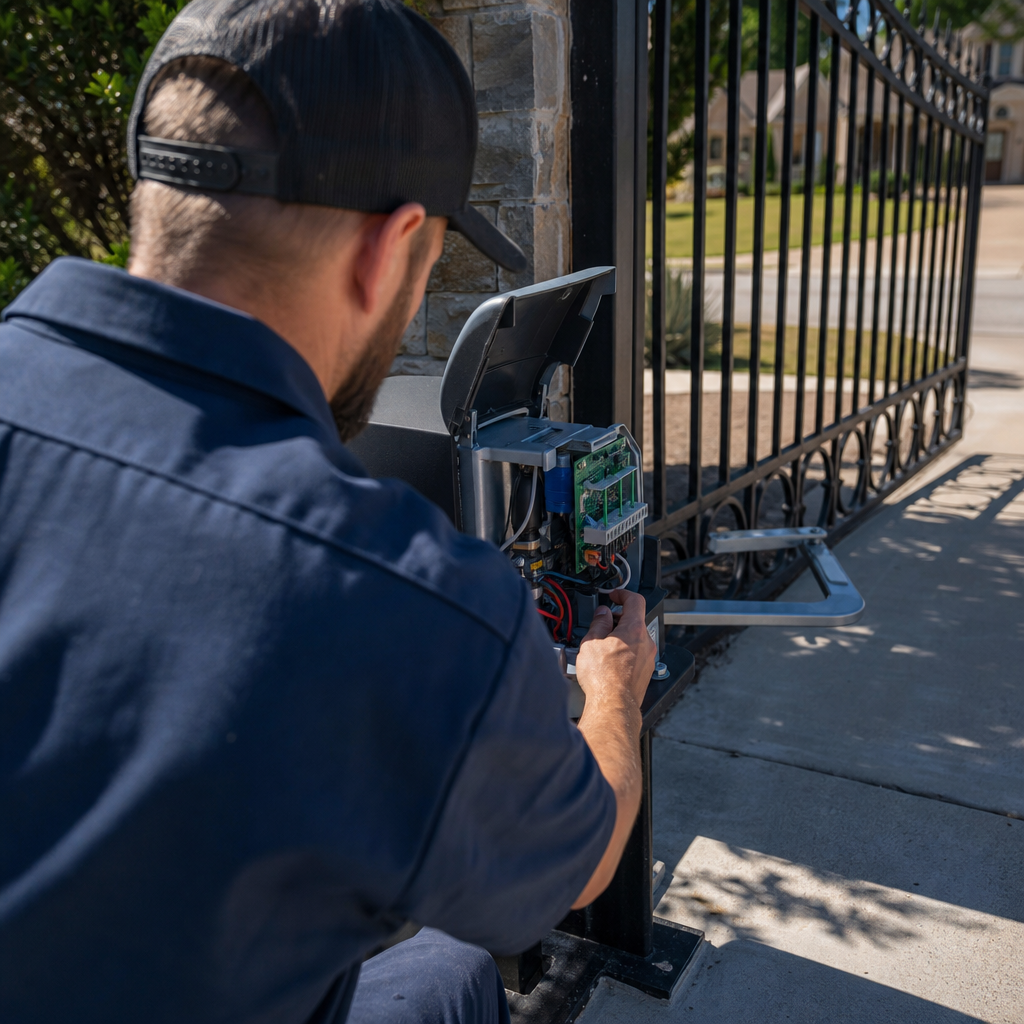
If your gate is stuck open and needs to be closed manually, exercise caution. Keep people clear of the gate path, avoid pinch points, do not force heavy, damaged, or obstructed gates, and obtain qualified service when safe movement is uncertain.
- Turn off automatic operation: Turn off automatic operation or disconnect power if safe to do so before attempting manual movement.
- Use manual release: Use only the manufacturer’s manual release or emergency-disconnect procedure as specified in the operator manual. Do not force the gate.
- Move the gate carefully: Push the gate closed slowly, keeping hands clear of pinch points, hinges, and rollers. If the gate resists, do not force it.
- Secure the gate: Use the designed latch or lock only after the gate is fully closed. Do not use a temporary chain and padlock unless confirmed safe and compatible by the gate manufacturer or a qualified technician.
How to Reset an Automatic Gate Opener
Need electric gate not closing?
We’re available now - call for a fast, free estimate.
To reset a gate operator, follow only the manufacturer’s documented reset procedure outlined in the equipment manual. Do not disconnect battery terminals or touch exposed electrical wiring unless the manual specifically permits and directs it. If faults persist after performing the documented reset, seek qualified service.
When to Call a Professional Gate Technician
While clearing light debris from a photo eye or track are basic tasks, structural, heavy-gate, and electrical problems require professional assistance from providers such as Ironworks Gate Co. Do not work on exposed electrical components or attempt structural modifications. Contact a qualified gate repair technician when:
- The gate leaf is visibly sagging, leaning, or dragging on the driveway surface.
- The motor hums or grinds without moving the gate.
- The control board displays persistent error codes related to internal board faults, memory loss, or failed loop detectors.
- Hinge weld joints or mounting post footings show cracks or structural degradation.
- Commercial facilities experience access failures during peak traffic periods, risking employee safety or asset security.
Frequently Asked Questions
Why does my electric gate open but will not close?
Safety faults can prevent closing or cause reversal, depending on the operator design. An active safety device, such as blocked, misaligned, unpowered, or interfered-with optical safety eyes, is a common possibility. Check sensor alignment and cleanliness according to the manufacturer manual.
What causes an electric gate to reverse before closing completely?
Premature reversal is one potential cause related to mechanical drag or safety obstruction sensing. When the gate encounters a rough spot on the track, stiff hinges, or wind resistance, the motor current increases, which the control board may interpret as an obstacle.
How do I test and realign gate safety sensors?
Sensor indicator behavior, blinking patterns, and alignment steps vary by manufacturer and model. Consult your operator manual for exact instructions. Clean the optical covers with a damp microfiber cloth, verify bracket alignment per the manual, and never bypass or disable safety sensors.
How do I manually close and lock a stuck electric gate?
Turn off automatic operation if safe, and follow the manufacturer’s manual release or emergency-disconnect procedure. Keep people clear, avoid pinch points, and push the gate closed slowly without forcing it. Use the designed latch or lock only after the gate is fully closed, and obtain qualified service if safe movement is uncertain.
When should I call a professional technician for electric gate repair?
Call a qualified technician if the gate is physically sagging, hinges or posts are structurally compromised, the motor fails to move the leaf, or electrical components need service. Never work on exposed electrical components or bypass safety systems.
Need electric gate not closing?
We’re available now - call for a fast, free estimate.
Sources
- Microsoft Word – BVS Final Rule for Gates and Enclosures – cpsc.gov
- First conviction of an owners corporation over industrial gate … – safework.nsw.gov.au (2023)
- Risks to pedestrians from crushing zones on electrically … – hse.gov.uk (2010)
Related reading: Automatic Gate Troubleshooting – Call Now-10% Off – Same-Day Service – Free Estimate
Related reading: Security Gate Repair | 10% Off & Free Estimate | On-Site in 60 Minutes
Related reading: Automatic Gate Repair Cost | Call Now-10% Off | On-Site in 60 Minutes | Free Estimate
Frequently Asked Questions
How do extreme weather and shifting soil prevent an electric gate from closing?
Soil expansion can tilt mounting posts out of plumb, while temperature swings cause metal tracks to expand and create physical friction. When the operator detects this added mechanical drag, internal force monitors interpret the resistance as an obstruction and prevent the gate from closing. Technicians at Ironworks Gate Co. can realign shifted tracks and adjust operator torque settings to resolve environmental binding.
Is it safe to bypass safety photo eyes to force a stuck gate closed?
No, bypassing optical sensors violates UL 325 safety standards and creates severe entrapment hazards for vehicles and pedestrians. If your photo eyes fail to register alignment, disengage the operator's manual emergency release to push the gate shut safely. For persistent sensor wiring or logic board issues, contact Ironworks Gate Co. for same-day professional diagnostics.
What causes an electric gate motor to hum or click without moving toward the closed position?
A humming motor typically points to a failed starting capacitor, damaged internal drive gears, low supply voltage, or severe mechanical binding. Attempting to force the operator can burn out the motor windings or damage the logic board. The technical specialists at Ironworks Gate Co. provide on-site electrical testing to pinpoint whether mechanical replacement or circuit board repair is required.
About the author
 |
Steven Caldwell Steven Caldwell is a licensed access control technician and technical writer with over 12 years of experience in residential and commercial gate systems. He holds an associate degree in electronics technology from Tarrant County College. Drawing on his field experience, Steven writes informative guides to help property owners in North Texas understand gate maintenance, troubleshoot common issues, and navigate repair costs. |
Gate not opening, off track, or opener dead?
We’re available now - call for a fast, free estimate.
Call Now - Free Estimate