
Quick Summary
Automated driveway gates often malfunction due to power interruptions, misaligned optical sensors, or mechanical track binding, creating urgent security concerns and severe entrapment hazards. As a premier local automation authority, Ironworks Gate Co. resolves complex electric gate repair issues on the first visit through certified diagnostic troubleshooting and fully stocked mobile response units. After reviewing these diagnostic steps, readers will understand safe maintenance boundaries and can contact the 24/7 live dispatch team to schedule a free on-site assessment for fast same-day repair.
Electric Gate Repair: Troubleshooting, Root Causes, and Service Guide
When an automated driveway or security gate stops moving, the issue may involve mechanical binding, electrical power issues, or safety sensor interruptions. Diagnosing an electric gate requires inspecting the physical structure, hardware condition, and electrical controls together.[3]
While automated gate systems provide daily convenience and property security, they also involve heavy moving parts and high-torque motors. According to the U.S. Consumer Product Safety Commission (CPSC), automatic-gate hazards primarily involve entrapment and crushing between a moving gate and a stationary object. The CPSC estimated nearly 25,000 people were involved in automatic-gate injuries, including about 9,000 children under 15, during 1990 through 2000, along with 32 deaths related to automatic gates since 1985, including 20 child deaths. Safe troubleshooting means respecting these physical forces and knowing when to hand the job over to a professional driveway gate repair service like Ironworks Gate Co.[1] See also Electric Gate Troubleshooting | Call Now-10% Off | Same-Day Service | Free Estimate.
Electric Gate Troubleshooting: What to Check First
Before calling for emergency gate repair or taking apart your control box, run through a few basic checks. Gate operators frequently shut down due to minor interruptions in power or blocked optical beams rather than total mechanical failure.[4]
Immediate Safety Warning: Entrapment and Pinch Points
Under safety standards described by the CPSC and Underwriters Laboratories (UL), automated gates are designed to incorporate entrapment-prevention provisions, such as built-in motor reverse sensors paired with external photo-eyes or safety edge sensors, depending on the application and jurisdiction. Never bypass, disable, or bridge safety terminals to force a gate to close. If a gate reverses direction or refuses to move, it is often responding to a triggered safety circuit.[2]
Quick Diagnostic Checklist
- Verify the Main Power Supply: Check your breaker panel and any local disconnect switch near the operator. Storms, grid flickers, and tripped GFCI outlets are common culprits.
- Check the Safety Photo-Eyes: Ensure the optical lenses are clean and unobstructed by dirt or debris.
- Inspect the Travel Path: On a sliding electric gate, check for gravel or debris wedged in the ground track. On swing gates, check for ground scrape or debris near the hinge post.
- Check Remote Batteries and Keypads: Verify whether the gate fails to respond to all inputs (remotes, keypads, intercoms) or just one specific transmitter.
Basic Tools and Safety Precautions for Gate Diagnosis
Homeowners and facility managers can handle basic visual inspections safely. Keep a level, a reliable flashlight, and a soft microfiber cloth handy. For mechanical checks, have your operator manual disconnect key ready.
Visual and Mechanical Inspection
Use a level against hinge posts or slide gate support stanchions to check for structural alignment. Keep ground tracks clean and refer to the manufacturer manual for proper maintenance and lubrication procedures.
Electrical Safety Precautions
Line-voltage supplies (120V or 230V) inside the operator housing present real shock hazards. Low-voltage control circuits can also short out if probed incorrectly, damaging main boards. Property owners should keep inspections visual. If an electrical issue extends beyond resetting a breaker or changing an external accessory fuse, hire an electric gate opener repair specialist such as Ironworks Gate Co.
Step 1: Check Visible Power Feeds and Manual Release
A gate that appears completely dead usually has a power delivery problem. Start at the main electrical service panel before touching the motor.
Checking Power Feeds
- Inspect the dedicated gate circuit breaker in your main electrical panel. If tripped, reset it once. If it trips again immediately, consult an electrician or gate technician.
- Check any external GFCI outlets tied into the gate feed. Moisture often trips outdoor GFCI receptacles.
- Open the operator housing and check whether power is reaching the main circuit board.
Manual Release Operation
When you are dealing with an electric gate not working after power outage events, you may need to switch to manual operation to move the gate leaf. Many operators have a manual-release mechanism; consult the manufacturer manual for the specific model:
- Swing Gate Actuators: Often use a keyed release or a twist-cam on the arm to disengage the drive.
- Sliding Gate Openers: Often use a foot pedal release, a hand crank, or a keyed mechanical clutch.
- Underground Operators: Often use a specialized release lever fitted near the motor shoe.
Disengage the drive slowly. If the gate swings or rolls freely by hand without resistance, your mechanical hardware is intact, pointing the diagnostic focus toward electrical supplies or motor electronics.
Step 2: Inspect Safety Sensors and Optical Alignment
Need electric gate repair?
We’re available now - call for a fast, free estimate.
Safety photo-eyes prevent the gate from closing on vehicles, pets, or pedestrians. When an optical sensor malfunctions, the control board defaults to a fail-safe state, refusing to close the gate.
Sensor Alignment and Cleaning
- Check Optical Alignment: Ensure transmitter and receiver or reflector units are properly aligned and unobstructed.
- Wipe Down the Lenses: Clear dust, dirt, or debris from the sensor lenses with a clean, soft cloth.
- Inspect Reflector Panels: On retro-reflective sensor setups, ensure the reflector is intact, clean, and properly aligned with the emitter.
Step 3: Inspect Physical Gate Alignment and Site Conditions
Physical gate components can bind over time, placing excessive strain on mechanical and electrical systems.
Physical Obstructions, Hinges, and Track Binding
- Sliding Gates: Check the wheels and ground track for obstructions, dirt, or physical damage that may impede movement.
- Swing Gates: Check the hinges and gate leaf for wear, binding, or misalignment.
- Gate Structure: Inspect the frame to ensure it is not sagging or dragging along the ground surface.
Step 4: Motor and Control System Diagnostics
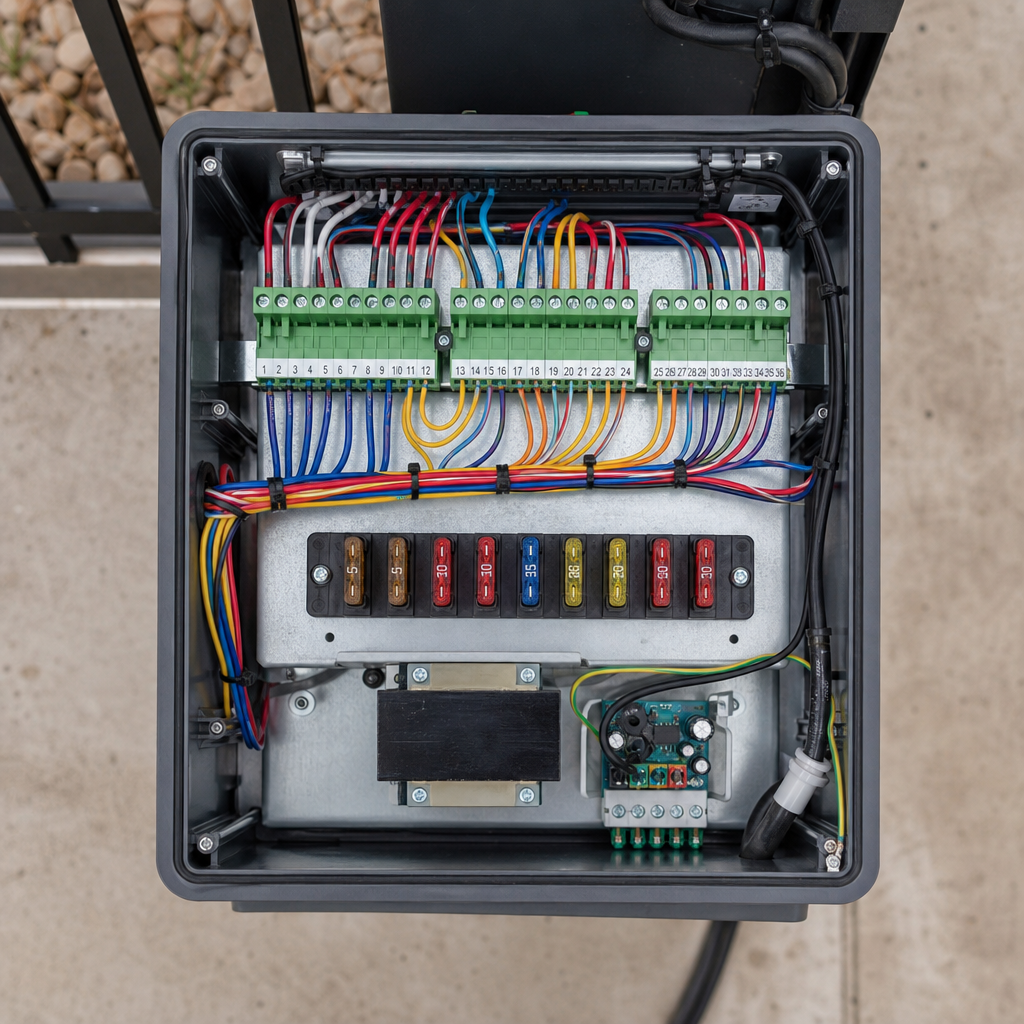
If the physical gate moves smoothly by hand and the sensors are clean, the issue lies within the operator cabinet or motor assembly.
Safe Troubleshooting Steps
- Listen to the Operator: Note whether the motor hums, clicks, or shows signs of electrical response when activated.
- Inspect the Control Cabinet: Check for visible signs of damage, blown fuses, or loose wiring connections.
- Check Limit Switches: Ensure limit switches or sensors are properly positioned and functioning according to the manufacturer specifications.
If internal drive components are damaged or electrical faults persist, professional service or replacement from a specialist like Ironworks Gate Co. may be required.
Step 5: Test Keypads, Transmitters, and Access Controls
Access control peripherals take severe weather abuse. Before replacing parts, isolate whether the trigger device itself is malfunctioning.
Transmitters and Wireless Controls
Replace remote batteries and inspect battery contacts for wear or corrosion. Ensure the antenna is properly positioned according to manufacturer guidelines.
Hardwired Keypads and Access Peripherals
- Inspect Access Controls: Check external keypads, card readers, or intercoms for physical wear, damage, or loose connections.
- Verify Input Signals: A qualified technician can verify whether the access control device is sending the appropriate open or close signal to the control board.
Step 6: Evaluating Repair vs. Replacement
Need electric gate repair?
We’re available now - call for a fast, free estimate.
Deciding between repairing an existing operator or installing a replacement depends on factors such as part availability, safety features, and the overall mechanical and structural condition of the gate system.
- Consider Repair When: Replacement parts are readily available and the failure is limited to serviceable components.
- Consider Replacement When: Replacement parts are obsolete, safety features are outdated, or major mechanical and structural components are severely damaged.
What Does Electric Gate Repair Cost?
The available research does not support a dependable general price range for electric gate repair. Prices vary by fault, parts, gate type, labor, and location.
Because automated systems involve unique mechanical spans and electrical configurations, general price quotes online are rarely reliable. Contact a qualified local contractor such as Ironworks Gate Co. to get a detailed on-site assessment and written estimate based on your specific gate setup.
Professional Gate Service
Residential and commercial systems rely on specialized operators designed for specific applications and gate configurations. When selecting a contractor for gate repair or maintenance, look for qualified technicians who have experience with your specific operator model and access to appropriate replacement parts.
Frequently Asked Questions About Electric Gate Repair
Why is my electric gate not opening or closing?
The most common causes are blocked or misaligned safety photo-eyes, a tripped power breaker, dead remote batteries, or mechanical binding. Check whether the motor makes any sound when triggered and check that safety sensors are aligned and unobstructed.
Why is my electric gate not working after a power outage?
Power outages are often accompanied by electrical surges that can trip local GFCI outlets, blow control board fuses, or damage surge suppressors. Additionally, if the gate was opened manually during the outage, the mechanical release must be firmly re-engaged before the motor will drive the gate again.
How do I troubleshoot an electric gate motor issue?
Start by disengaging the manual release (if equipped, following manufacturer instructions) to check whether the gate moves smoothly by hand. If physical movement is stiff, inspect hinges, wheels, and alignment. If the gate moves freely, check power feeds, limit switches, and control board connections.
Can I manually open an electric gate when the power goes out?
Manual opening is usually possible when the operator has a manual-release mechanism, following the manufacturer’s instructions. Disengaging the motor allows the gate to be moved manually until power is restored.
How often should an electric gate be serviced or inspected?
A Secure21 case study recommends yearly servicing. Routine maintenance generally includes clearing tracks, testing safety reversing devices, tightening hardware, and inspecting overall gate alignment.
What are the most common reasons electric gate sensors fail?
Sensors frequently fail due to physical misalignment, optical beam obstructions, or dirt and debris coating the sensor lenses.
Is DIY gate repair safe?
Homeowners can safely handle basic tasks like cleaning photo-eyes, clearing track debris, changing remote batteries, and testing manual release keys. However, internal high-voltage electrical diagnostics, motor gearbox teardowns, hinge welding, and structural post realignments should always be handled by professional technicians like Ironworks Gate Co. to avoid severe injury and ensure property security.
Need electric gate repair?
We’re available now - call for a fast, free estimate.
Sources
- New Safety Standard for Automatic Security Gates Helps … – cpsc.gov (2000)
- [PDF] Investigation Guideline Product: Automatic Gate Operators Appendix – reginfo.gov (2000)
- Gate Automation Market Research Report 2034 – marketintelo.com (2034)
- STUDY: BABY GATE INJURIES HAVE NEARLY QUADRUPLED – msnewsroommedia.s3.amazonaws.com (2014)
Related reading: Automatic Gate Opener Problems | Call Now-10% Off | Same-Day Service | Free Estimate
Related reading: Gate Opener Troubleshooting | Call Now-10% Off | Same-Day Service | Free Estimate
Related reading: Electric Gate Manual Release Key | 10% Off & Free Estimate | Same-Day Service
Frequently Asked Questions
How quickly can an electric gate repair be completed on-site?
Most common failures involving optical sensors, blown control board fuses, or track binding can be diagnosed and fixed the same day. Ironworks Gate Co. deploys fully stocked mobile units staffed with certified technicians to resolve operator and hardware faults on the first visit. Property owners experiencing urgent access or security issues can contact the 24/7 live dispatch team for immediate same-day service.
How do I get an accurate cost estimate for electric gate repair?
Because repair costs depend on specific operator models, safety compliance hardware, and unique site conditions, generalized online price charts are rarely dependable. Ironworks Gate Co. provides free on-site gate assessments to thoroughly inspect the physical and electrical components of your system. Following the diagnostic inspection, you receive an upfront, written estimate tailored to your exact repair needs.
What signs indicate an electric gate opener needs replacement instead of repair?
Replacement is recommended when operator replacement parts are obsolete, structural motor mounts are cracked, or the system lacks modern UL-compliant entrapment safety devices. If the malfunction is limited to serviceable elements like capacitors, limit switches, or optical eyes, component repair is the more practical choice. Ironworks Gate Co. conducts comprehensive evaluations to help property owners determine whether repair or replacement is the most cost-effective path.
About the author
 |
Steven Caldwell Steven Caldwell is a licensed access control technician and technical writer with over 12 years of experience in residential and commercial gate systems. He holds an associate degree in electronics technology from Tarrant County College. Drawing on his field experience, Steven writes informative guides to help property owners in North Texas understand gate maintenance, troubleshoot common issues, and navigate repair costs. |
Gate not opening, off track, or opener dead?
We’re available now - call for a fast, free estimate.
Call Now - Free Estimate