
Quick Summary
Ground dragging caused by loose hinges, racked framing, or shifting soil makes learning how to fix a sagging wooden gate essential to prevent latch failure and automatic opener strain. While minor alignment issues can be corrected using lag screws, diagonal braces, or turnbuckle kits, Ironworks Gate Co. emphasizes that heavy or wide gates often require structural solutions like welded steel subframes or reset concrete footings. After reading, you will understand how to diagnose root causes of gate drag, complete step-by-step hardware adjustments, and determine when to schedule a professional gate repair or post replacement.
Fix a Sagging Wooden Gate and Reduce Ground Dragging
A wooden gate that scrapes across the driveway or digs into the turf is one of the most common property headaches. When a gate starts dragging, the latch stops catching, the hinges take excessive strain, and automatic gate openers can bind or wear out their drive mechanisms. Getting the gate swinging freely again requires identifying whether the problem lies in loose hinges, a racked wooden frame, or a post shifting underground.[4]
Wood is naturally hygroscopic, meaning it absorbs and releases moisture from the surrounding air. Daily humidity swings cause minor expansion and contraction, while seasonal weather shifts can cause significant dimensional changes across the wood grain. Moisture control can reduce dimensional changes, and while surface coatings and sealers slow down moisture transfer, they do not prevent it completely. When moisture expansion combines with structural stress, undersized hardware can fail and framing joints can begin to slip.[1] See also Electric Gate Troubleshooting | Call Now-10% Off | Same-Day Service | Free Estimate.
Note: The following repair procedures represent general installation and maintenance guidance rather than research-verified findings.
Step 1: Check for Post Deflection and Soil Movement (General Guidance)
Before buying hardware or adjusting screws, inspect the hinge post. In areas with reactive clay soils, soil can expand during wet periods and shrink during dry spells. This sub-surface shifting can pull concrete footings out of plumb.
If your hinge post is leaning inward, installing a wood gate anti-sag kit or adding a diagonal brace to the gate leaf will not solve the underlying issue. Cranking down a turnbuckle cable on a gate hung from a leaning post can pull the wooden frame out of its natural plane, causing the gate to twist under tension.
To inspect the post:
- Check for plumb: Place a level against both the front and side faces of the hinge post. If the bubble is off-center toward the opening, the post footing may have deflected.
- Check for rot at the base: Press a scratch awl or screwdriver into the wood where it meets the ground or concrete collar. If the wood feels soft or spongy, decay may have compromised the structural base.
- Look for concrete cracking: Check whether the concrete footing has fractured, lifted, or separated from the surrounding soil.
If you have a leaning or rotted post, you may need to realign or reset the post in a new footing before working on the gate panel itself.
Step 2: Reinforce or Replace Strained Gate Hinges (General Guidance)
The top hinge on a swing gate carries outward tension away from the post, while the bottom hinge absorbs compression by pushing into the post. Over time, wind resistance and gate weight can loosen factory-supplied screws, causing the latch end to drop.
To reinforce the hinge connection:
- Prop up the latch side of the gate with wood blocks or a pry bar so the hinge screws are relieved of panel weight.
- Inspect the top hinge for stripped screws or bent mounting leaves.
- Remove any short, factory-supplied screws one by one.
- If the screw holes in the post are stripped, pack them tightly with hardwood dowels or wood splinters coated in waterproof exterior wood glue, then let the glue set.
- Drive heavy-duty exterior structural lag screws through the hinge plate directly into the center of the post framing.
For wider gates or heavy solid-wood panels, standard utility hinges can bend. Specialists like Ironworks Gate Co. recommend replacing them with heavy-duty strap hinges or ball-bearing pivot hinges that distribute weight over a wider surface area.[5]
Step 3: Install an Anti-Sag Turnbuckle Kit or Diagonal Brace (General Guidance)
Need fix sagging wooden gate?
We’re available now - call for a fast, free estimate.
If the post is plumb and the hinges are tight, the sag is often caused by the rectangular frame racking into a parallelogram. You can pull the frame back into square using either a tension cable kit or a solid wood compression brace.
Understanding Diagonal Brace Direction
The direction of your diagonal support depends on whether the material works under tension (pulling) or compression (pushing):
- Tension cable (Steel turnbuckle kit): Run the steel cable from the top corner on the hinge side down to the bottom corner on the latch side. Tightening the turnbuckle pulls the sagging bottom latch corner upward toward the secure top hinge.
- Compression brace (Solid lumber strut): Run a solid wood brace diagonally from the bottom corner on the hinge side up to the top corner on the latch side. The brace transfers the downward load of the outer panel into the bottom hinge and post.
Installing a wood compression brace in the reverse direction places the fasteners under tension, which can accelerate joint loosening.
Sagging Gate Turnbuckle Installation Steps
- Mount the upper corner bracket at the top hinge corner of the gate frame.
- Mount the lower corner bracket at the bottom corner on the latch side.
- Extend the center turnbuckle so threading is available for future adjustments.
- Thread the cable through the brackets and secure it with the included cable clamps.
- Turn the turnbuckle body using a wrench or screwdriver until the cable tensions and lifts the gate sufficiently to clear the ground and engage the latch cleanly.
Step 4: True the Wooden Frame and Secure Corner Joints (General Guidance)
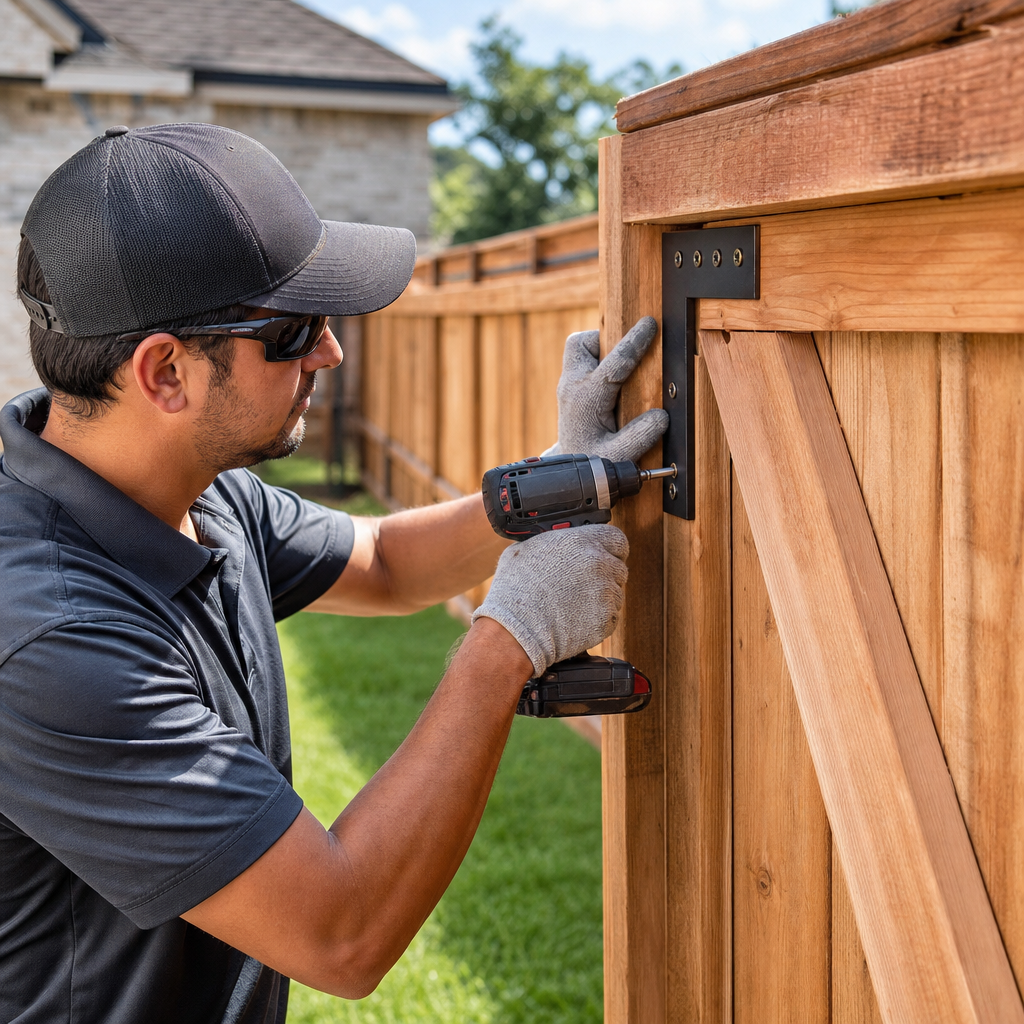
To help keep the gate square over time, reinforce the interior framing corners where seasonal moisture changes can loosen fasteners in wood joints:[2]
- Lift the outer edge of the gate using wooden shims until a level shows the top rail is aligned.
- Attach steel L-brackets or flat corner plates to each inside joint of the wooden frame using exterior-rated screws.
- Ensure that end-grain cuts on pickets and rails are treated with exterior stain, primer, or sealer to slow moisture absorption and reduce dimensional movement.
Step 5: Structural Upgrades for Wide or Heavy Gates (General Guidance)
Standard wooden framing has structural limits under outdoor exposure. For wider or heavier gates, simple hardware adjustments may only provide temporary relief.
Steel Subframe Reinforcement
As recommended by fabricators such as Ironworks Gate Co., one reinforcement option is to build or retrofit a welded steel or aluminum subframe behind the wooden pickets. A metal subframe can help the gate resist sagging, twisting, and corner racking while preserving the natural wood appearance from the front.
Gate Helper Wheels and Casters
For manual gates swinging over smooth, level surfaces, a spring-loaded gate caster mounted beneath the latch-side corner can support part of the panel weight. Helper wheels serve as auxiliary support and will not correct a leaning post or operate effectively over uneven turf or gravel.
Impact of Gate Sag on Automatic Driveway Gate Openers (General Guidance)
Need fix sagging wooden gate?
We’re available now - call for a fast, free estimate.
On automated gates, a dragging panel increases physical resistance against electric gate operators, which can lead to operational problems:
- Clutch slippage and gear damage: Mechanical drive components can experience excessive wear when forced to push a dragging gate across ground obstructions.
- Obstruction sensor reversals: Gate motors with built-in resistance detection may read ground friction as an obstruction and reverse direction automatically.
- Motor limit resets: If an operator stalls due to dragging, resolve the structural alignment first. Once the panel swings freely by hand, consult the manufacturer instructions to recalibrate the motor travel limits.
According to Ironworks Gate Co., routine driveway gate maintenance should include verifying panel ground clearance and lubricating hinge points before adjusting motor force settings.
When to Repair vs. When to Replace a Wooden Gate
| Condition | Recommended Action |
|---|---|
| Loose hinge screws, minor frame drop, sound post | Install structural lag screws and anti-sag turnbuckle |
| Split frame lumber, warped pickets, sound post | Rebuild frame or add internal reinforcement subframe |
| Post leaning due to soil shift or cracked concrete | Excavate, straighten, and reset post in concrete footing |
| Severe ground-line post rot and cracked joints | Full gate and post replacement |
Frequently Asked Questions
Why is my wooden gate sagging and scraping the ground?
Wooden gates commonly drag due to loose or stripped hinge fasteners, a racked frame where square corners have shifted, or a hinge post that has tilted in shifting soil. Seasonal moisture shifts also cause dimensional expansion and contraction that can loosen joints over time.[3]
How do you fix a sagging wood gate without replacing it?
If the post is plumb and solid, you can address gate drag by supporting the latch corner, replacing loose hinge screws with heavy-duty exterior lag screws, and installing an anti-sag cable kit running diagonally from the top hinge corner to the bottom latch corner.
What should you look for in an anti-sag gate kit?
Look for kits featuring weather-resistant galvanized or stainless steel cable, durable corner brackets, and an adjustable turnbuckle that provides sufficient threading for future tension adjustments.
How do I adjust or reinforce gate hinges to fix sagging?
Relieve panel weight with a wedge or pry bar, remove loose fasteners from the top hinge, fill stripped holes with exterior wood glue and wood splinters, and drive heavy-duty exterior lag screws into the post. If the hinge plate is bent, upgrade to heavy-duty strap or commercial hinges.
When should I repair a sagging gate versus replacing the entire gate?
Repair the gate if the issue is limited to loose fasteners, minor frame racking, or surface movement. Consider replacing the gate or post if the wood has significant decay, if framing rails have split, or if the concrete footing is structurally compromised.
How much does professional wooden gate repair cost?
Repair costs vary depending on gate size, site accessibility, local labor rates, and whether the issue is a simple hardware adjustment or a major structural repair such as resetting a post footing.
Need fix sagging wooden gate?
We’re available now - call for a fast, free estimate.
Sources
- Chapter 13: Drying and control of moisture content and dimensional … – research.fs.usda.gov (2021)
- Moisture relations and physical properties of wood – research.fs.usda.gov (2010)
- Drying and control of moisture content and dimensional changes – research.fs.usda.gov
- Wood Handbook, Chapter 13: Drying and Control of Moisture Content – research.fs.usda.gov
- Dimensional Stability of Wood – fpl.fs.usda.gov
Related reading: Sagging Gate Repair – Call Now-10% Off – On-Site in 60 Minutes – Free Estimate
Related reading: Electric Gate Repair | 10% Off & Free Estimate | On-Site in 60 Minutes
Related reading: Automatic Gate Opener Problems | Call Now-10% Off | Same-Day Service | Free Estimate
Frequently Asked Questions
Can an anti-sag turnbuckle kit fix a wooden gate if the hinge post is leaning?
No, turnbuckle kits and diagonal braces only pull a racked wooden frame back into square and cannot correct a shifting foundation. If soil movement or rot has tilted the hinge post, Ironworks Gate Co. recommends excavating and resetting the post in a reinforced concrete footing before making any gate panel adjustments.
How does a welded steel subframe prevent wide wooden gates from sagging repeatedly?
Natural wood inevitably flexes, expands, and weakens at fastener joints when exposed to outdoor humidity and heavy structural loads. Retrofitting a welded steel subframe behind the wood pickets transfers the load to rigid metal, permanently eliminating corner racking while preserving the wooden aesthetic.
How do I get my automatic gate opener working properly after fixing ground drag?
First, disconnect the opener arm to confirm the gate swings completely free by hand without scraping or hinge binding. Once full physical clearance is restored, consult your opener manual to recalibrate the motor travel limits and reset the obstruction force settings.
About the author
 |
Steven Caldwell Steven Caldwell is a licensed access control technician and technical writer with over 12 years of experience in residential and commercial gate systems. He holds an associate degree in electronics technology from Tarrant County College. Drawing on his field experience, Steven writes informative guides to help property owners in North Texas understand gate maintenance, troubleshoot common issues, and navigate repair costs. |
Gate not opening, off track, or opener dead?
We’re available now - call for a fast, free estimate.
Call Now - Free Estimate