
Quick Summary
Installing an anti sag kit for wooden gate frames can quickly realign minor corner drops, but surface tension hardware often fails when underlying issues involve leaning posts, worn hinges, or water-logged lumber. Gate specialists at Ironworks Gate Co. explain that while turnbuckle cables and compression braces stabilize sound lightweight panels, heavy gates and automated systems frequently require structural sub-frame reinforcement for lasting alignment. After reading, property owners will understand proper brace geometry, accurately diagnose whether sagging stems from joint fatigue or post failure, and know when to seek an on-site structural assessment.
Anti Sag Kit for Wooden Gate: Restore Alignment Fast
When a wooden gate begins scraping across the driveway or missing its latch striker, reaching for a bolt-on turnbuckle kit is a common quick reaction. Installing an anti sag kit for wooden gate frames can help re-square a lightweight panel. However, basic cable kits may struggle under the weight of water-logged pickets, wide spans, or shifting soil conditions.[3]
While DIY corner brackets and tension wires help adjust minor frame drop, they do not fix rotten posts, worn hinge pins, or structural wood failure. Understanding how these kits distribute load, as technicians at Ironworks Gate Co. explain, helps you decide whether a basic adjustment will work or if your entryway would benefit from structural reinforcement. See also Electric Gate Troubleshooting | Call Now-10% Off | Same-Day Service | Free Estimate.
How an Anti Sag Kit for Wooden Gate Works (and When It Fails)
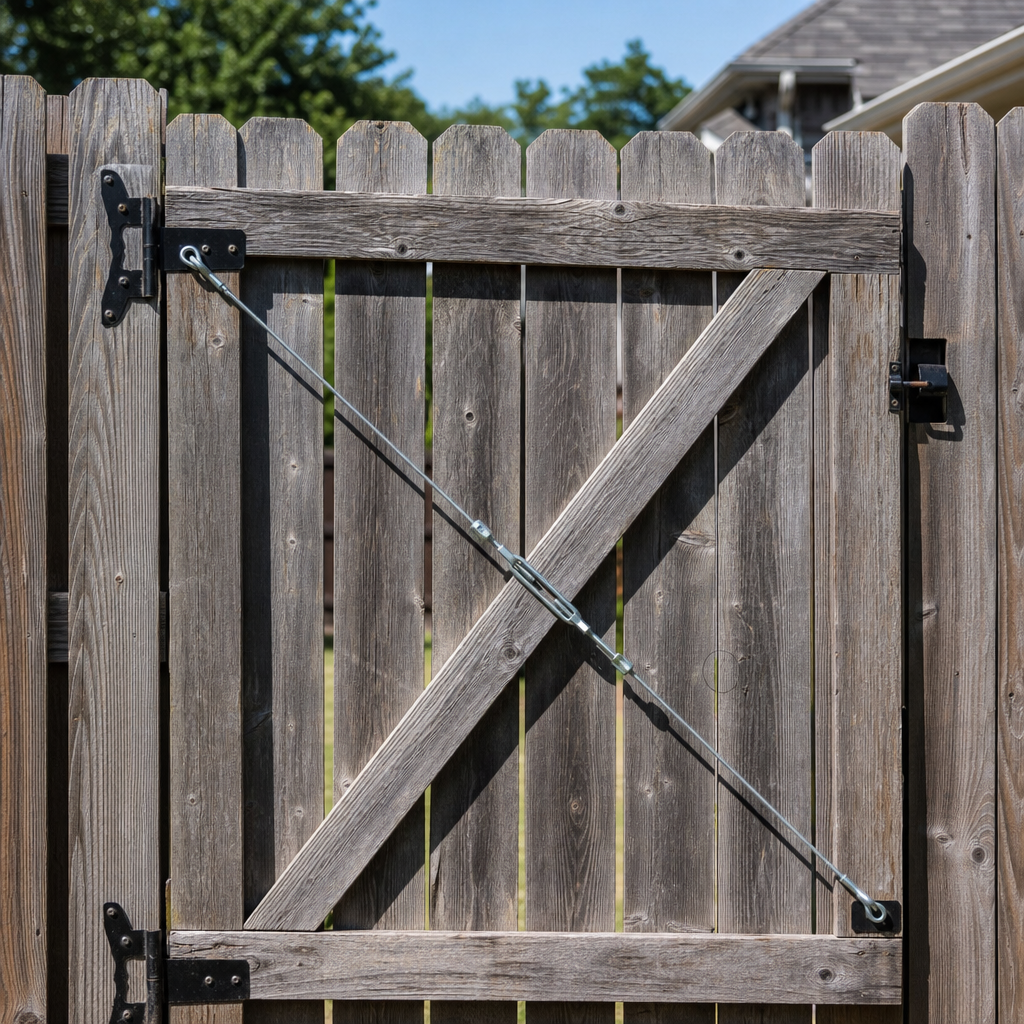
How an Anti Sag Kit for a Wooden Gate Works: An anti-sag setup helps support a dropped latch corner by distributing weight back toward the hinge post. Tension cable systems typically mount from the top hinge corner to the bottom latch corner to pull the frame upward. Rigid compression braces are an installation option running from the bottom hinge corner toward the latch side to support the frame from beneath.
Most basic hardware kits rely on surface-mounted tension. When you tighten a center turnbuckle, the cable shortens and pulls the bottom outer corner up toward the top hinge. This can work on lightweight gates with sound framing. On heavier or wider gates, tension placed on corner mounting points may cause fasteners to loosen or framing lumber to distort over time.
Cable Turnbuckle Kits vs. Rigid Metal Bracing
Hardware selection depends on gate width, weight, material, hinge condition, post stability, and frame support. Cable kits are adjustable, while rigid braces may provide fixed support and may be preferable where greater stiffness is needed:[2]
| Feature | Cable Turnbuckle Kit | Rigid Metal Bracing Kit |
|---|---|---|
| Mechanical Action | Tension (pulls the latch corner up toward the top hinge) | Compression (supports the latch corner from the bottom hinge area) |
| Hardware Components | Steel cable, corner brackets, adjustable turnbuckle | Steel or aluminum structural strut, bracket shoes |
| Application Considerations | Adjustable; suitable for lighter gates with sound framing | Fixed support; may be preferred when additional stiffness is needed |
| Potential Limitations | Fasteners may loosen under high tension or heavy loads | Brackets or framing may distort if gate load exceeds capacity |
Proper Installation Geometry: Corner to Corner Alignment
Depending on the design and manufacturer recommendations, common brace alignments include:
- Tension setups (Cables): Anchor the top bracket at the upper hinge corner and the bottom bracket at the lower latch corner. Tightening the turnbuckle draws the dropped latch edge upward toward the top hinge.
- Compression setups (Rigid Braces): An installation option is mounting the lower bracket near the bottom hinge corner and running the rigid strut diagonally toward the upper latch area to transfer outer gate weight toward the lower hinge pivot.
Installing a tension wire or rigid brace opposite its intended design orientation can reduce effectiveness or distort the frame.
Critical Gate Components That Cause Sagging: Hinges, Posts, and Openers
A gate that drags on the ground may be suffering from issues beyond loose frame joints. Diagnosing the entire opening prevents relying on surface hardware when the primary problem involves the ground or pivot points.
Hinge Wear and Post Deflection
A swinging wooden gate functions as a lever arm. Weight extending outward from the post increases rotational force applied to the upper hinge. Over time, hinge components can wear and mounting screws may loosen inside framing lumber.
Post deflection can also cause alignment issues. In areas where soil shifts due to moisture changes, support posts may lean under the weight of a gate. An anti-sag kit can help re-square the wooden frame, but it cannot pull a tilted support post back to plumb. Adjusting hardware against a leaning post may bind the hinges.
How a Sagging Gate Affects Automatic Gate Openers
For automated driveways, gate alignment is important. When a gate panel drops, changes in swing geometry can create mechanical resistance, requiring the electric operator to push against misaligned hinges or ground contact.
Many gate operators use internal current sensing to detect obstacles. When mechanical resistance increases, the control system may interpret the load as an obstruction, potentially causing the gate to stop or reverse. Continued operation under excessive resistance can increase wear on drive components.
Environmental Stress and Frame Support
Need anti sag kit for wooden gate?
We’re available now - call for a fast, free estimate.
Wood expands and contracts with ambient humidity. During wet seasons, wooden pickets absorb moisture and add dead weight to the gate leaf. During dry periods, lumber can shrink and warp.
Surface-mounted cable kits do not fully prevent wood from twisting along its face. When tension is applied to a warped frame, the latch side may remain out of alignment with the latch strike. For heavy, wide, or damaged gates, seeking structural reinforcement, such as an integrated metal sub-frame recommended by Ironworks Gate Co., can help support structural loads independently of the wood pickets.
When an Anti-Sag Kit Works vs. When to Rebuild
Before purchasing hardware, inspect the entire entryway. Hardware selection depends on gate width, weight, material, hinge condition, post stability, and frame support:
- Consider a DIY Turnbuckle or Brace Kit If: The support post is plumb, the hinges are sound, the lumber is free of rot, the gate is relatively light, and the frame has experienced minor settling at the corner joints.
- Consider Structural Reinforcement or Rebuilding If: The gate is heavy or wide, the wooden frame is rotted or damaged around fasteners, the support post is unstable or out of plumb, or the gate connects to an automatic opener requiring rigid alignment.
Frequently Asked Questions About Wooden Gate Sag Repair
How does an anti sag kit work on a wooden gate?
An anti-sag kit helps transfer downward load from the unsupported latch corner back toward the hinge post. A tension cable lifts the dropped corner toward the top hinge, while a rigid compression brace can provide support from the bottom hinge corner upward.
Which direction should the anti-sag cable or brace be installed?
A tension cable is typically run from the top hinge corner down to the bottom latch corner. As an installation option, a rigid compression brace is often oriented from the bottom hinge corner up toward the top latch corner.
Can an anti-sag kit fix an already sagging wooden gate or only prevent it?
An anti-sag kit can help adjust and re-square a sagging gate, provided the frame lumber is sound and the hinge post is plumb. If the post is leaning or the hinges are failing, surface hardware alone will not resolve the issue.
Is a turnbuckle cable kit better than a metal diagonal brace?
Cable kits are adjustable via a turnbuckle, while rigid braces may provide fixed support and may be preferable where greater stiffness is needed. Hardware selection depends on gate width, weight, material, hinge condition, post stability, and frame support.
How much weight can a standard wooden gate anti-sag kit support?
Load capacity depends on specific product design and manufacturer specifications. The available research identifies no authoritative neutral statistics on anti-sag kit service life, failure rate, market size, or general load capacity, so consult the product documentation for rated limits.[1]
When is a gate too damaged for an anti-sag kit and needs professional repair?
According to Ironworks Gate Co., a gate may require structural reinforcement or professional repair when the hinge post is loose in the ground, structural lumber around hinge bolts has decayed, the frame is severely warped, or an automated opener experiences persistent mechanical binding.
Need anti sag kit for wooden gate?
We’re available now - call for a fast, free estimate.
Sources
- ASDB Forensic Report – tucson.com (2026)
- Gate Hinges for Wooden Gates: A Complete 2026 Guide – xtremeedeals.ca (2026)
- vevor.com – vevor.com
Related reading: Fix Sagging Wooden Gate – Call Now-10% Off – Same-Day Service – Free Estimate
Related reading: Electric Gate Repair | 10% Off & Free Estimate | On-Site in 60 Minutes
Related reading: Automatic Gate Opener Problems | Call Now-10% Off | Same-Day Service | Free Estimate
Frequently Asked Questions
How often do you need to adjust an anti-sag kit turnbuckle on a wooden gate?
Because wooden gates expand and contract with seasonal humidity, turnbuckle cables typically require minor tension adjustments once or twice a year. If you find yourself tightening the kit frequently without restoring alignment, Ironworks Gate Co. recommends an on-site assessment to inspect for loose hinges or shifting support posts.
Why is my wooden gate still dragging on the ground after installing an anti-sag kit?
If your gate panel is properly squared but still drags, the issue is likely a leaning support post, worn hinge pins, or shifting soil at the footing. Anti-sag hardware only corrects diagonal frame drop and cannot pull a deflected hinge post back into plumb.
When should you upgrade to a steel sub-frame instead of a bolt-on anti-sag kit?
An anti-sag kit suits lightweight pedestrian gates, but heavy wood privacy panels, wide spans, and automated gates require an integrated steel sub-frame. Ironworks Gate Co. designs welded metal frames that support the entire gate load, eliminating fastener tear-out and preventing damage to electric gate openers.
About the author
 |
Steven Caldwell Steven Caldwell is a licensed access control technician and technical writer with over 12 years of experience in residential and commercial gate systems. He holds an associate degree in electronics technology from Tarrant County College. Drawing on his field experience, Steven writes informative guides to help property owners in North Texas understand gate maintenance, troubleshoot common issues, and navigate repair costs. |
Gate not opening, off track, or opener dead?
We’re available now - call for a fast, free estimate.
Call Now - Free Estimate